30Sep
What Really Happens to Your Natural Teeth When Getting Porcelain Veneers
Written by Kourosh Seifolahi Bazarjani, DDS – Advanced Education in General Dentistry (AEGD)
Porcelain veneers do require permanently removing a thin layer of enamel, but when the preparation stays within that enamel layer, your underlying tooth structure remains healthy and intact. The real risk comes from over-preparation or misaligned teeth that force deeper shaving — understanding that distinction changes everything about how you evaluate this procedure. If you’re located in Fairfax County VA, our team can help you determine whether veneers are the right fit for your smile goals.
Why the 0.5mm Shaving Depth Is a Biological Threshold, Not Just a Number
Most explanations of veneer prep reduce it to “we shave off half a millimeter.” That description is technically accurate but clinically incomplete, and it leaves out the part that actually matters. For Centreville-area patients considering treatment, understanding tooth anatomy is critical.
Your tooth has two structural layers above the pulp: enamel on the outside, and dentin underneath. The boundary between them is called the dentin-enamel junction (DEJ). When a veneer preparation stays within the enamel layer, the veneer bonds to a surface that’s dense, mineralized, and chemically ideal for adhesive bonding. When the preparation crosses that junction and reaches dentin, bond strength drops significantly — and the consequences compound from there.
Dentin is porous and contains fluid-filled tubules that connect to the pulp. Bonding to dentin is less reliable, which increases the risk of microleakage at the veneer margin. Over time, that microleakage can allow bacteria to penetrate, leading to sensitivity, pulpitis, or decay developing beneath a restoration that looks perfectly fine from the outside. A Healthline overview of dental veneers notes that traditional veneer prep involves grinding past the enamel in some cases — and that’s precisely the scenario I work hard to avoid.
In my practice, I use digital scanning and careful case planning to keep preparations conservative. For most patients with relatively aligned, healthy teeth, the prep stays comfortably within enamel. That’s the clinical goal: enough reduction to seat the veneer flush with surrounding teeth, without compromising the biological surface that makes adhesive bonding durable and protective.
The takeaway here is simple. The number “0.5mm” only tells you the depth. Whether that depth stays in enamel or enters dentin tells you whether the procedure is minimally invasive or genuinely risky to the tooth underneath.
Crooked Teeth and Veneers: The Hidden Enamel Sacrifice Most Patients Don’t Anticipate
Here’s something I discuss with almost every veneer consultation involving misaligned teeth: the amount of enamel removed is not uniform across patients. It depends heavily on the starting position of each tooth.
When a tooth is rotated, overlapping, or protruding forward, the veneer shell needs to sit at a position that creates a uniform, natural-looking arch. To achieve that, the protruding surface must be reduced significantly more than the standard 0.5mm. In some cases, that reduction exceeds what enamel alone can provide — which means the preparation enters dentin, and everything discussed in the previous section becomes a real clinical concern.
This is why I sometimes recommend a short course of clear aligner therapy — typically two to four months — before veneer preparation for patients with mild to moderate crowding. By moving teeth closer to their ideal arch position first, the subsequent veneer prep can remain conservative and within enamel on every tooth. The alternative — veneering over rotated or protruding teeth without orthodontic pre-alignment — forces asymmetric shaving that permanently removes more tooth structure than necessary.
According to WebMD, veneers are used to address crooked, uneven, or oddly shaped teeth, and they can absolutely achieve that result. The clinical question is how much tooth structure gets sacrificed to get there, and whether a brief alignment phase could protect that structure long-term.
For patients whose primary concern is alignment rather than color or shape, clear aligners alone may be the better path. For patients who want both alignment correction and cosmetic refinement, sequencing orthodontics before veneers gives the best outcome with the least biological cost. Our cosmetic dentist team can walk you through both options in detail.
The 30-Year Lifecycle of a Veneered Tooth: What Replacements Actually Mean
Porcelain veneers last roughly 10 to 15 years on average, with well-placed restorations sometimes reaching 20 years. As Healthline explains in their veneers-vs-crowns overview, veneers cover only the front surface of the tooth — about 1mm in thickness — while crowns cover the entire tooth at approximately 2mm.
That lifespan creates a lifecycle that patients getting veneers in their late twenties or thirties rarely think through. If you get veneers at 30, you’re likely facing your first replacement around age 42 to 45, a second around 55 to 60, and potentially a third in your seventies. Each replacement cycle requires removing the old veneer and re-preparing the tooth surface.
Here’s the structural reality: each re-prep removes another micro-layer of tooth. The enamel that was already thinned during the first preparation doesn’t regenerate. By the second or third replacement cycle, remaining enamel may be insufficient to support another veneer, and the preparation depth inevitably reaches dentin — or deeper. That’s the clinical point at which a veneer is no longer the right restoration, and a full-coverage crown becomes necessary. It’s also worth understanding the signs you might need a root canal, since deep preparation that reaches the pulp can sometimes trigger that need.
This isn’t a reason to avoid veneers. It’s a reason to choose them thoughtfully, maintain them carefully, and plan for the long term. Patients who grind their teeth and don’t wear a night guard accelerate this timeline considerably. Modern Erbium laser debonding techniques, where available, remove old veneers with less collateral damage to the underlying tooth than traditional bur drilling — which is one reason technique and technology matter at each replacement cycle.
The American Dental Association’s MouthHealthy resource emphasizes that only a licensed dentist should place veneers — partly because unlicensed providers may place veneers over unhealthy teeth, accelerating exactly this kind of structural decline without the patient knowing.
Understanding this lifecycle doesn’t make veneers a bad choice. It makes you a better-informed patient who can weigh the procedure against your age, tooth health, and long-term dental goals. Learning how to choose the right dentist in Virginia for long-term oral health is an important first step in that process.
What the Actual Procedure Involves, Step by Step
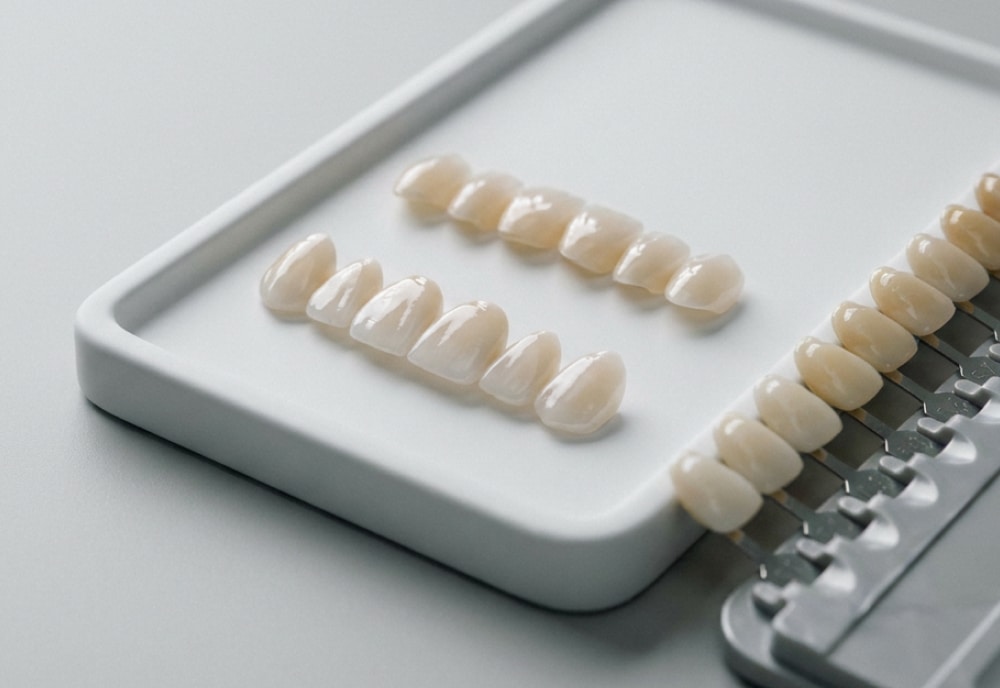
Once candidacy is confirmed, the preparation appointment is where the permanent change happens. After numbing the area, I remove a controlled amount of enamel from the front surface of each tooth being treated. A digital scan or physical impression captures the prepared tooth geometry precisely.
According to the ADA’s MouthHealthy guidance, that impression or 3D model goes to a dental lab where a technician custom-fabricates the veneer to fit. Temporary acrylic veneers protect the prepared teeth in the interim. When the permanent veneers return, each one is checked for fit and shade, then bonded using a specialized cement and light-cured in place.
For patients who qualify, same-day CAD/CAM fabrication eliminates the temporary phase entirely — the veneer is designed and milled in-office during a single visit. A Healthline guide on no-prep veneers notes that digital impressions can enable same-day placement in some cases, which also reduces the window during which prepared teeth are vulnerable.
After placement, the bite is checked carefully. It may take a few days to feel fully natural. Long-term, avoiding biting hard objects, wearing a night guard if you grind, and maintaining regular hygiene appointments all extend veneer lifespan — and protect the tooth structure underneath. Staying current with routine dental X-rays for early detection is also essential to catching any issues beneath your restorations before they become serious.
Ready to Find Out If Veneers Are Right for You?
If you’re considering porcelain veneers and want a clear-eyed assessment of what the procedure means for your specific teeth, I’d encourage you to start with a thorough consultation. At Total Dental Arts in Centreville, I use digital scanning and AI-assisted treatment planning to map out exactly how much preparation your teeth require — and whether a short orthodontic phase first would protect more of your natural tooth structure. Serving patients throughout Fairfax County and the surrounding area including Oakton VA, we’re here to help you make a decision you’ll still feel confident about 20 years from now.
Medical disclaimer: This article is intended for informational purposes only and does not constitute professional dental or medical advice. Individual clinical situations vary. Please consult a licensed dental professional for diagnosis and personalized treatment recommendations.